(Words: ~2000)
Knowledge is like a sphere, the greater its volume, the larger its contact with the unknown. --Blaise Pascal"When information doubles," the futurist/economist
Robert Theobald once said, "knowledge halves and wisdom quarters." By most contemporary accounts, though, information is not
merely doubling; rather, as
Kevin Kelly argues, "
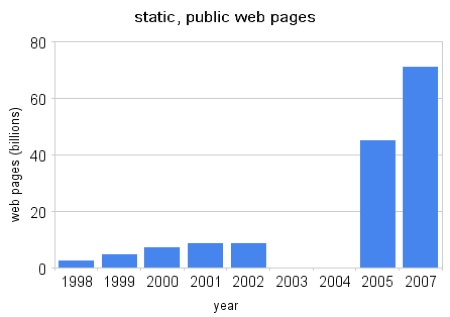
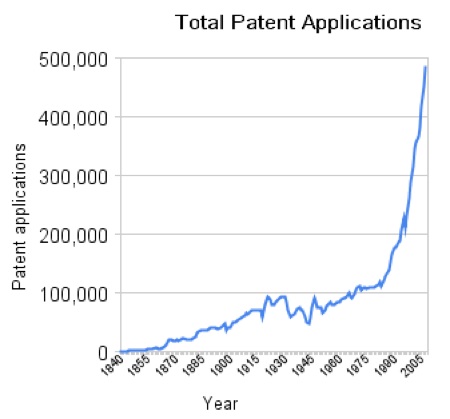
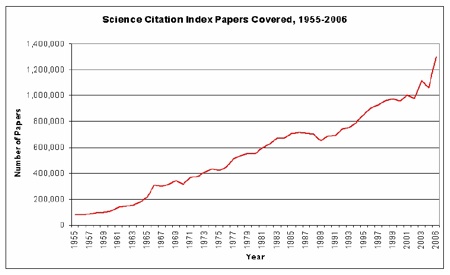
the fastest growing entity today is information." (Indeed, the very study of information contributes to its rapid expansion.) According to Kelly and Google economist Hal Varian, "world-wide information has been increasing at the rate of 66% per year for many decades." As they show, this information growth is manifest in the number of
public websites,
inventions patented, and
scientific articles published. Similarly, as I show in the following two graphs, the number of international journals (selected because of their high "
impact factor") has increased significantly over the last century+, both in Science (Figure 1) and Philosophy (Figure 2). This is no surprise, of course, given the phenomenon of academic specialization (which was once said to produce "
people who know more and more about less and less, until they know all about nothing").

Figure 1: The number of notable Science journals from 1860 - 2007.

Figure 2: The number of notable Philosophy journals from 1900 - 2008.
And along with disciplinary and vocational specialization comes linguistic specialization, or the creation of new vocabularies and terminologies. Thus, it follows that the English language is expanding too, as the following graph confirms (Figure 3). Here, I plot the number of
entries in various dictionaries, from
Dr. Johnson's
A Dictionary of the English Language to the
OED's Third Edition (anticipated in
2037), against the years they were published. As linguists will confirm, the English language (now the
lingua franca of the world) is larger today than any language has ever been in anthropological history.
 Figure 3: The growth of the English language; see the bottom of post for information about individual dictionaries.
If we accept Theobald's assertion, then, it follows that knowledge and wisdom are rapidly shrinking, at an inverse rate of information growth. Thus, despite the wonders of modern science, it appears that humans are today becoming increasingly ignorant, rather than knowledgeable and wise. (The humanist psychologist Erich Fromm once wrote with solicitude: "We have the know-how, but we do not have the know-why, nor the know-what-for.") It seems, then, that an adequate "theory of ignorance" (cf. "theory of knowledge") is needed, to make sense of the observed patterns of information growth and human understanding (the explanandum), as well as to examine the implications of these patterns for the transhumanist program.
Maybe, though, the word 'despite' in the paragraph above is misleading; maybe the best locution is 'because of'. On this view, it is because of modern science that humanity finds itself in its epistemic plight of ignorance. This is precisely the position championed by Kelly, who argues that modern science increases both the quantity of answers and the quantity of questions, but it increases the latter faster than the former--exponentially faster, in fact (Figure 4). Thus, if one characterizes ignorance as the difference between questions (known but without answers) and answers (given to known questions), then human ignorance is expanding at an exponential rate.

Figure 4: Kevin Kelly's graphic illustration of the growth of ignorance.
But
why, if Kelly is correct, does this phenomenon occur? The answer: Kelly's thesis rests upon the plausible claim that every new answer formulated by scientists introduces greater-than-or-equal-to 2 novel questions. The result is that science, like technology (which always has "
unintended consequences" and "
negative externalities"), becomes a self-perpetuating enterprise, built upon a positive-feedback loop in which scientific work
creates the possibility for more scientific work. In other words,
enlightenment leads to benightedness, science entails nescience. Thus,
this ostensibly paradoxical expansion of ignorance is precisely what makes
scientific "progress" possible; as Albert Einstein once observed: "
We can't solve problems by using the same kind of thinking we used when we created them." Thus, we change our thinking, and in doing so science "progresses."
There are, for a theory of ignorance, many important questions to be asked. To begin, one might inquire about the
sources of human ignorance: In what ways can one become ignorant? This question, indeed, has a long and venerable history. For example, in the thirteenth century,
Roger Bacon--a forward-thinking Franciscan friar with empiricist leanings--identified "four causes of human ignorance," namely (i) authority, (ii) custom, (iii) popular opinion, and (iv) pride of supposed knowledge. Later, echoing R. Bacon's work, the natural philosopher
Francis Bacon delineated a typology of "
Idols," including those of the Tribe, the Den, the Marketplace and the Theater. These Idols, F. Bacon argued, are truth-distorting and as such have no place in an epistemologically respectable new empirical science.
Another issue pertains to the distinction between
individual and
collective ignorance. For example, although
I know very little about how the
Large Hadron Collider (LHC) actually works, it is nonetheless true that
scientists (specifically physicists) know, and in great theoretical detail. Thus, while
I am ignorant of the inner workings of the LHC, the collective
we--which includes laypersons and experts--is knowledgeable. Such collective knowing by groups composed of individually ignorant scientists has, to be sure, become the norm today: so-called "
Big Science," which commenced with the Manhattan Project, involves large numbers of scientists working on particular problems in groups structured according to an "intellectual division of labor." (Recall here
Hilary Putnam's notion of a "
division of linguistic labor" and Figure 3 above.) The end-result is a solution to a problem that no single scientist fully understands--the
whole "knows" but its
parts do not.
We must, therefore, define 'ignorance' for the group and the individual differently. On Kelly's view, which focuses on the collective group (rather than the individual), ignorance is the "widening gap" between the group's collectively held questions and its collectively held answers. In contrast, individual ignorance is characterizable (along these lines) as
the difference between the group's collectively held questions and the individual's personally held answers. Thus, as humans collectively acquire more questions, the individual finds him or herself increasingly dwarfed by his or her relativistic ignorance. This is roughly, I believe, what that Langdon Winner is getting at when
he writes: "If ignorance is measured by the amount of available knowledge that an individual or collective 'knower' does not comprehend, one must admit that ignorance, that is
relative ignorance, is growing." (Although here one must interpret "knowledge" as referring inclusively to the unanswered questions that form the upper curve of Kelly's graph.)
Furthermore, the individual is far more constrained by (what I call) the "breadth/depth trade-off" than the group: given our common "
finitary predicament" (which involves constraints imposed by time, memory, etc.), the
knowledge-depth of any given individual tends to be
inversely related to his or her
knowledge-breadth. (Culture, on the other hand, is transgenerationally cumulative--it doesn't have to start over each time a generation dies out.) One can thus imagine a spectrum of knowers ranging from experts on one side to jack-of-all-trades on the other, where the former has a parochial focus and the latter a sciolistic understanding. This gestures at two
sources of
individual ignorance, which we might articulate as follows: (i) breadth-ignorance from knowledge-depth, and (ii) depth-ignorance from knowledge-breadth.
We have, in the above paragraphs, borrowed and elaborated Kelley's
definition of 'ignorance'. But the concept of
ignorance is, I believe, further analyzable. Consider, for example, Kelly's notion of a question. To state the obvious, there are questions that we
know, and questions that have not yet been formulated--that is, questions that we
don't know. Kelly considers only the former in characterizing collective ignorance. It is possible, though, that infinitely (or maybe finitely?) many questions exist that we are not yet aware of--e.g., abstruse questions that a future theory
X brings to our attention--just as pre-twentieth century physicists were not yet aware of the (apparent)
theoretical incompatibility of quantum mechanics and relativity theory.
The fifteenth century polymath and "
apophatic" theologian
Nicholas of Cusa seems to capture this distinction with his "
doctrine of learned ignorance." According to Nicholas, ignorance and knowledge are not wholly distinct epistemic phenomena, but combine and overlap in interesting ways. As Nicholas writes: "
The more [a wise person] knows that he is unknowing, the more learned he will be." In other words, "
learned ignorance is not altogether ignorance," but a kind of knowledge or wisdom. (Socrates had a similar thought with his proclamation that "All I know is that I know nothing.") Applying this to Kelly's graph, then, the upper curve constitutes not ignorance
simpliciter, but a sort of quasi-knowledge or
learned ignorance revealed by science. As Deborah Best and Margaret Jean Intron-Peterson claim, "
it takes knowledge to acknowledge ignorance, and it takes acknowledgment to inquire and face what we do not know. [...]
Ignorance is neither a void nor lack. Rather, it is a plenum: full and fertile." Kelly's claim that science leads to more ignorance than knowledge thus
may be misleading.
This kind of ignorance, then, involves a sort of "meta-knowledge," or second-order knowing about (not) knowing. Indeed, one can't know what one doesn't know, but one can know that one doesn't know. Witte et al. make these logical possibilities explicit in their tripartite distinction between (i) known ignorance (A knows that he/she doesn't know p); (ii) unknown ignorance (A doesn't know that he/she doesn't know p); and (iii) pseudoknowledge (A thinks he/she knows p but she doesn't). Kelly accepts the first and third (what matters here is the objective fact about what one does not know and what he or she does know); I'm not even sure how to represent the second on a graph since there may be an infinite number of questions--a dotted-line of "unknown unknowns" that forever hovers above the exponential curve. On this view, then, science is a process of converting unknown questions to known questions, and then attempting to answer them.
Our discussion thus far yields the following sexipartite matrix (Figure 5):
 Figure 5: Different kinds of ignorance, based on Kelly's distinction between questions and answers and Witte et al.'s distinction explicated above.
Finally, in concluding this post, the discussion so far may constitute a compelling premise in an argument for a "transhumanism future." That is to say, the existence of innate "limits" of human cognition precludes Homo sapiens today from fully comprehending the massively complex system of sociotechnics upon which the cultural superstructure is built. We are, at least from one perspective, becoming increasingly ignorant both individually and collectively, and without knowledge of how the sociotechnical system works we cannot hope to control it, contain it, or use it for good. Cognitively "superior" posthuman creatures who can fathom advanced technology, therefore, may be required to reduce the probability of self-annihilation and global collapse.
Thus, ignorance theory has implications for transhumanism as a normative thesis about whether certain kinds of technological projects (robotics, specifically Strong AI) should be pursued. On my view, given the discussion above, it probably should. But, of course, I may be ignorant.
"Knowledge is not happiness, and science but an exchange of ignorance for that which is another kind of ignorance."
Key to Figure 3:
1755: A Dictionary of the English Language (Dr. Johnson)
1828: An American Dictionary of the English Language (Webster)
1860: An American Dictionary of the English Language (Webster-Mahn Edition)
1884: OED, First Edition
1890: Webster's International Dictionary of the English Language (Porter)
1900: Webster's International Dictionary of the English Language (republished with supplemental words)
1909: Webster's New International Dictionary (Harris & Allen)
1934: Webster's New International Dictionary, Second Edition (Neilson & Knott; contains many nonce words; is thus currently the largest English dictionary)
1961: Webster's Third New International Dictionary of the English Language, Unabridged
1989: OED, Second Edition
2005: OED (with added words)
2009: OED (with added words)
2037: OED, Third Edition
 Figure 1: Graph of Moore's Law, from 1971 to 2008.
 Figure 2: Kurzweil's "Countdown to the Singularity" graph.
 Figure 3: Bostrom's typology of risks, ranging from the personal (scale) and endurable (intensity) to the global (scale) and terminal (intensity). The latter, global-terminal risks are "existential."
 Figure 4: Rapid increase in the number of existential risks, from pre-1945 to 2045.
 Figure 5: A graph sketching out the approximate increase in the probability of an existential disaster from 1945 - 2045. (The Cold War period may be an exception to the curve shown, which may or may not be exponential; see below.)