[This is a revised version of an article previously published on the Institute of Ethics and Emerging Technology website.]
Basic research is what I'm doing when I don't know what I'm doing.
– Wernher Von Braun
CERN's Large Hadron Collider (LHC), a product of the biggest Big Science project in human history, has recently been in the news for having “smashed beams of protons together at energies that are 3.5 times higher than previously achieved.” This achievement stimulated thought, once again, about my ambivalence towards the LHC. The feeling arises from a conflict between (a) my “epistemophilia,” or love of knowledge, and (b) specific moral considerations concerning what sorts of pursuits ought to have priority given the particular world we happen to inhabit. In explaining this conflict, I would like to suggest two ways the LHC's funds could have been better spent, as well as respond to a few defenses of the LHC.
Moral and Practical Considerations
In 2008, the former UK chief scientist Sir David King criticized the LHC for being a “blue skies” project[1], arguing that “the challenges of the 21st Century are qualitatively different from anything that we've had to face up to before,” and that “this requires a re-think of priorities in science and technology.” In other words, couldn't the >$6 billion that funded the LHC have been better spent on other endeavors, projects or programs?
I am inclined to answer this question positively: YES, the money could have been better spent. Why? For at least two reasons[2]:
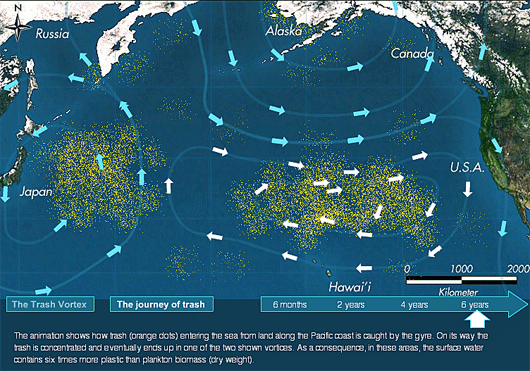
(1) Morally speaking, there is an expanding manifold of “sub-existential risk” scenarios that have been and are being actualized around the globe – scenarios that deserve immediate moral attention and urgent financial assistance. Thus, one wonders about the moral justifiability of “unnecessary” research projects in the affluent “First World” when nearly 16,000 children die of avoidable hunger-related illnesses every day; when water pollution kills more humans than all violence worldwide; when unregulated pharmaceuticals pollute public drinking water; when the Great Pacific Garbage Patch, superfund sites and eutrophication threaten the very livability of our lonely planet in space.
Ascending from the “personal/local/global” to the “transgenerational” level of analysis, there exists a growing mass of increasingly ominous existential risks that demand serious scientific and philosophical study. Such risks are the most conspicuous reason why, as King observes above, the present moment in human history is “qualitatively different” from any prior epoch. Just 65 years ago, for example, there were only one or two “natural” existential risks. Looking at the present moment and into the near future, experts now count roughly 23 mostly anthropogenic types of existential risks (to say nothing of their tokens). Yet, as Nick Bostrom laments, “it is sad that humanity as a whole has not invested even a few million dollars to improve its thinking about how it may best ensure its own survival.” If any projects deserve $6 billion, in my opinion, it is those located within the still-incipient field of “secular eschatology.” More on this below.
(2) Practically speaking, one could argue that LHC's money could have been better spent developing “enhancement” technologies. Consider the fact that, if “strategies for engineered negligible senescence” (SENS) were perfected, the physicists now working on the LHC could have significantly more (life)time to pursue their various research projects. The development of such techno-strategies would thus be in the personal interest of anyone who, for example, wishes to see the protracted research projects on which they're working come to fruition. (As one author notes, the LHC extends beyond a single professional career[3].) Furthermore, healthspan-extending technologies promise to alleviate human suffering from a host of age-related pathologies, thus providing a more altruistic public good as well.
A similar argument could apply to the research domain of cognitive enhancements, such as nootropics, tissue grafts and neural implants. Again, in terms of the benefits for science, “a 'superficial' contribution that facilitates work across a wide range of domains can be worth much more than a relatively 'profound' contribution limited to one narrow field, just as a lake can contain a lot more water than a well, even if the well is deeper.”[4] Cognition-enhancing technologies would thus provide an appreciable boost not just to research on fundamental physics issues – the first billionth of a second after the Big Bang, the existence of the Higgs boson particle, etc. – but to the scientific enterprise as a whole.
Second, there may exist theories needed to understand observable phenomena that are in principle beyond our epistemic reach – that is, theories to which we are forever “cognitively closed.” The so-called “theory of everything,” or a theory elucidating the nature of conscious experience, might fall within this category. And the only plausible route out of this labyrinth, I believe, is to redefine the boundary between “problems” and “mysteries” via some techno-intervention on the brain. Otherwise, we may be trapped in a state of perennial ignorance with respect to those phenomena – floundering like a chimpanzee trying to conjugate a verb or calculate the GDP of China. Yet another reason to divert more funds towards “applied” enhancement research.
Furthermore, upgrading our mental software would augment our ability to evaluate the risks involved in LHC-like experiments. Physicists are, of course, overwhelmingly confident that the LHC is safe and thus will not produce a strangelet, vacuum bubble or microscopic black hole. (See the LSAG report.) But it is easy – especially for those who don't study the history and philosophy of science – to forget about the intrinsic fallibility of scientific research. When properly contextualized, then, such confidence appears consternatingly less impressive than one might initially think.
Consider, for example, Max Plank's oft-quoted comment that “a new scientific truth does not triumph by convincing its opponents and making them see the light, but rather because its opponents eventually die, and a new generation grows up that is familiar with it.” Thus, for all we know at present, the next generation of physicists, working within a modified framework of more advanced theory, will regard the LHC's risks as significant – just as the lobotomy, for which Egas Moniz won the science's most prestigious award, the Nobel Prize, in 1949, is now rejected as an ignominious violation of human autonomy. This point becomes even more incisive when one hears scientists describe the LHC as “certainly, by far, the biggest jump into the unknown” that research has ever made. (Or, recall Arthur Clarke's famous quip: "When a distinguished but elderly scientist states that something is possible, he is almost certainly right. When he states that something is impossible, he is very probably wrong.")
Critics of Critics
In response to such criticism, many scientists have vehemently defended the LHC. Brian Cox, for example, riposts “with an emphatic NO” to contrarians who suggest that “we [can] do something more useful with that kind of money.” But Cox's thesis, in my opinion, is not compelling. Consider the culmination of Cox's argument: “Most importantly, though, the world would be truly impoverished without all the fundamental knowledge we've gained” from projects like the LHC[5]. Now, at first glance, this claim seems quite reasonable. Without the “fundamental knowledge” provided by Darwinian theory, for example, it would be difficult (as Dawkins contends) to be an “intellectually fulfilled atheist.” This is an instance of science – by virtue of its pushing back the “envelope of ignorance” – significantly enriching the naturalistic worldview.
But Cox's assertion could also be construed as rather offensive. Why? Because the fact is that much of the world is quite literally impoverished. Thus, from the perspective of millions of people who struggle daily to satisfy the most basic needs of Maslow's hierarchy – people who aren't fortunate enough to live lives marked by “the leisure of the theory class,” with its “conspicuous consumption” of information – Cox's poverty argument for blue skies research is, at worst, an argument from intellectual vanity. It considers the costs of postponing physics research from a rather solipsistic perspective; and considering issues from the perspectives of others is, of course, the heart of ethics[6]. Surely if the roles were reversed and advocates of the LHC suddenly found themselves destitute in an “undeveloped” country, they would agree that the material needs of the needy (themselves) should take precedence over the intellectual needs of the privileged.
Furthermore, consider Sir Martin Rees' defense. “It is mistaken to claim,” Rees argues, “that global problems will be solved more quickly if only researchers would abandon their quest to understand the universe and knuckle down to work on an agenda of public or political concerns. These are not 'either/or' options – indeed, there is a positive symbiosis between them.”
But, in my view, the existence of such symbioses is immaterial. The issue instead concerns how resources, including money and scientists, are best put to use. A retort to Rees could thus go as follows: there is a crucial difference between making every effort, and making merely some effort, to exorcise the specter of existential and other related risks that haunts the present millennium. Thus, if one is seriously concerned about the future of humanity, then one should give research directly aimed at solving these historically unique conundra of eschatological proportions strong priority over any project that could, at best, only “indirectly” or “fortuitously” improve the prospects of life on Earth.
Rees' defense of the LHC is perplexing because he is (at least ostensibly) quite concerned with secular eschatology. In his portentous book Our Final Hour, Rees argues that “the odds are no better than fifty-fifty that our present civilisation on Earth will survive to the end of the present century.” Similar figures have been suggested by futurologists like Bostrom, John Leslie and Richard Posner[7]. Thus, given such dismal probability estimates of human self-annihilation, efforts to justify the allocation of limited resources for blue skies projects appear otiose. As the notable champion of science, Bertrand Russell, once stated in a 1924 article inveighing against the space program, “we should address terrestrial problems first.”
In conclusion, it should be clear that the main thrust of my criticism here concerns the moral issue of existential risks. The present situation is, I believe, sufficiently dire to warrant the postponement of any endeavor, project or program that does not have a high probability of yielding results that could help contain the “qualitatively different” problems of the 21st century. This means that the LHC should be (temporarily) shut down. But even if one remains unmoved by such apocalyptic concerns, there are still good practical reasons for opposing, at the present moment, blue skies research: money could be better spent – or so the argument goes – developing effective enhancement technologies. Such artifacts might not only accelerate scientific “progress” but help alleviate human suffering too. Finally, I have suggested that some counterarguments put forth in defense of the LHC do not hold much water.
If we want to survive the present millennium, then we must, I believe, show that we are serious about solving the plethora of historically unique problems now confronting us.
[1] And as Brian Cox states, “there can be no better symbol of that pure curiosity-driven research than the Large Hadron Collider.”
[2] These are two distinct reasons for opposing the LHC – reasons that may or may not be compatible. For example, one might attempt to use the moral argument against the enhancement argument: spend money helping people now, rather than creating “enhancements” with dangerous new technology. Or, one might, as Mark Walker does, argue that the development of enhanced posthumans actually offers the best way of mitigating the risks mentioned in the moral argument.
[3] See this article, page 6.
[4] From this article by Bostrom.
[5] Space prevents me from considering Cox's additional arguments that “the world would be a far less comfortable place because of the loss to medicine alone, and a poorer place for the loss to commerce.” I would also controvert, to some extent, these assertions as well.
[6] This is the so-called “moral point of view.”
[7] Although Posner does not give an actual number.
Showing posts with label Bostrom. Show all posts
Showing posts with label Bostrom. Show all posts
April 8, 2010


March 25, 2009
An Existential Risk Singularity?
(Words: ~846)
The gravest existential risks facing us in the coming decades will be of our own making. --Transhumanist FAQ, Section 3.3
In the lexis of future studies, the term 'singularity' has numerous different meanings. For the present purposes, one can think of the singularity as, basically, the point at which the rate of technological change exceeds the capacity of any human to rationally comprehend it. (There are further questions about why this will occur, such as the total merging of biology and technology, the emergence of Strong AI, etc.) The postulation of this future event, which Ray Kurzweil expects to occur circa 2045, is based on a manifold of historical trends in technological development that evince an ostensibly exponential rate of change. Moore's Law (formulated by Gordon Moore, co-founder of Intel Corporation) is probably the most well-known "nomological generalization" of such an exponential trend (Figure 1).
 Figure 1: Graph of Moore's Law, from 1971 to 2008.
In The Singularity is Near, Kurzweil plots a number of "key milestones of both biological evolution and human technological development" on a logarithmic scale, and discovers an unequivocal pattern of "continual acceleration" (e.g., "two billion years from the origin of life to cells; fourteen years from the PC to the World Wide Web"; etc.) (Figure 2). (See also Theodore Modis.) And from this trend, Kurzweil and other futurists extrapolate a future singular event at which the world as we now know it will undergo a radical transmogrification. (Indeed, the singularity can be thought of as an "event horizon," beyond which current humans cannot "see.")
 Figure 2: Kurzweil's "Countdown to the Singularity" graph.
What I am interested in here is the possibility of an "existential risk singularity," or future point at which the rate of existential risk creation exceeds our human capacity for rational comprehension--as well as mitigation and control (yet another reason for developing posthumans). Consider, for example, Nick Bostrom's observation that existential risks (which instantiate the 'X' in Figure 3) "are a recent phenomenon." That is to say, nearly all of the risks that threaten to either (ex)terminate or significantly compromise the potential of earth-originating intelligent life stem directly from "dual use" technologies of neoteric origin. In a word, such risks are "technogenic."
 Figure 3: Bostrom's typology of risks, ranging from the personal (scale) and endurable (intensity) to the global (scale) and terminal (intensity). The latter, global-terminal risks are "existential."
The most obvious example, and the one probably most vivid in the public mind, is nuclear warfare. But futurists unanimously expect technologies of the (already commenced) genetics, nanotechnology and robotics (GNR) revolution to bring with them a constellation of brand-new and historically unprecedented risks. As Bostrom discusses in his 2002 paper, prior to 1945, intelligent life was vulnerable to only a few, extremely low-probability events of catastrophic proportions. Today, Bostrom identifies ~23 risks to (post-)human existence, including disasters from nanotechnology, genetic engineering, unfriendly AI systems, and possible events falling within various "catch-all" categories (e.g., unforeseen consequences of unanticipated technological breakthroughs). Thus, since many of these risks are expect to arise within the next three decades, it follows that within only 100 years--from 1945 to 2045--the number of existential risks increased roughly 12-fold (Figure 4).
 Figure 4: Rapid increase in the number of existential risks, from pre-1945 to 2045.
But what about the probability? This issue is much more difficult to graph, of course. Nonetheless, we have three basic (although not entirely commensurate) data points, which at least gesture at a global trend: (i) the probability of a comet or asteroid impact per century is extremely low; (ii) John F. Kennedy once estimated the likelihood of nuclear war during the Cuban Missile Crisis to be "somewhere between one out of three and even"; and (iii) experts today estimate a subjective probability that Homo sapiens (the self-described "wise man") will self-immolate within the next century between 25% (Nick Bostrom) and 50% (Sir Martin Rees). In other words, our phylogenetic ancestors in the Pleistocene were virtually care free, in terms of existential risks; mid-to-late-twentieth century humans had to worry about a sudden and significant increase in the likelihood of annihilation through nuclear war; and future (post-)humans will, at least ostensibly, have to worry about a massive rise in both the number and probability of an existential catastrophe, through error or terror, use or abuse (Figure 5).
 Figure 5: A graph sketching out the approximate increase in the probability of an existential disaster from 1945 - 2045. (The Cold War period may be an exception to the curve shown, which may or may not be exponential; see below.)
Thus, given the apparent historical trends, it appears reasonable to postulate an existential risk singularity. This makes sense, of course, given that (a) nearly all of these risks are technogenic, and (b) as Kurzweil and others show, the development of numerous technologies is occurring at an exponential (even exponentially exponential) rate. One is therefore led to pose the question: Is the existential risk singularity near?
The gravest existential risks facing us in the coming decades will be of our own making. --Transhumanist FAQ, Section 3.3
In the lexis of future studies, the term 'singularity' has numerous different meanings. For the present purposes, one can think of the singularity as, basically, the point at which the rate of technological change exceeds the capacity of any human to rationally comprehend it. (There are further questions about why this will occur, such as the total merging of biology and technology, the emergence of Strong AI, etc.) The postulation of this future event, which Ray Kurzweil expects to occur circa 2045, is based on a manifold of historical trends in technological development that evince an ostensibly exponential rate of change. Moore's Law (formulated by Gordon Moore, co-founder of Intel Corporation) is probably the most well-known "nomological generalization" of such an exponential trend (Figure 1).
 Figure 1: Graph of Moore's Law, from 1971 to 2008.
In The Singularity is Near, Kurzweil plots a number of "key milestones of both biological evolution and human technological development" on a logarithmic scale, and discovers an unequivocal pattern of "continual acceleration" (e.g., "two billion years from the origin of life to cells; fourteen years from the PC to the World Wide Web"; etc.) (Figure 2). (See also Theodore Modis.) And from this trend, Kurzweil and other futurists extrapolate a future singular event at which the world as we now know it will undergo a radical transmogrification. (Indeed, the singularity can be thought of as an "event horizon," beyond which current humans cannot "see.")
 Figure 2: Kurzweil's "Countdown to the Singularity" graph.
What I am interested in here is the possibility of an "existential risk singularity," or future point at which the rate of existential risk creation exceeds our human capacity for rational comprehension--as well as mitigation and control (yet another reason for developing posthumans). Consider, for example, Nick Bostrom's observation that existential risks (which instantiate the 'X' in Figure 3) "are a recent phenomenon." That is to say, nearly all of the risks that threaten to either (ex)terminate or significantly compromise the potential of earth-originating intelligent life stem directly from "dual use" technologies of neoteric origin. In a word, such risks are "technogenic."
 Figure 3: Bostrom's typology of risks, ranging from the personal (scale) and endurable (intensity) to the global (scale) and terminal (intensity). The latter, global-terminal risks are "existential."
The most obvious example, and the one probably most vivid in the public mind, is nuclear warfare. But futurists unanimously expect technologies of the (already commenced) genetics, nanotechnology and robotics (GNR) revolution to bring with them a constellation of brand-new and historically unprecedented risks. As Bostrom discusses in his 2002 paper, prior to 1945, intelligent life was vulnerable to only a few, extremely low-probability events of catastrophic proportions. Today, Bostrom identifies ~23 risks to (post-)human existence, including disasters from nanotechnology, genetic engineering, unfriendly AI systems, and possible events falling within various "catch-all" categories (e.g., unforeseen consequences of unanticipated technological breakthroughs). Thus, since many of these risks are expect to arise within the next three decades, it follows that within only 100 years--from 1945 to 2045--the number of existential risks increased roughly 12-fold (Figure 4).
 Figure 4: Rapid increase in the number of existential risks, from pre-1945 to 2045.
But what about the probability? This issue is much more difficult to graph, of course. Nonetheless, we have three basic (although not entirely commensurate) data points, which at least gesture at a global trend: (i) the probability of a comet or asteroid impact per century is extremely low; (ii) John F. Kennedy once estimated the likelihood of nuclear war during the Cuban Missile Crisis to be "somewhere between one out of three and even"; and (iii) experts today estimate a subjective probability that Homo sapiens (the self-described "wise man") will self-immolate within the next century between 25% (Nick Bostrom) and 50% (Sir Martin Rees). In other words, our phylogenetic ancestors in the Pleistocene were virtually care free, in terms of existential risks; mid-to-late-twentieth century humans had to worry about a sudden and significant increase in the likelihood of annihilation through nuclear war; and future (post-)humans will, at least ostensibly, have to worry about a massive rise in both the number and probability of an existential catastrophe, through error or terror, use or abuse (Figure 5).
 Figure 5: A graph sketching out the approximate increase in the probability of an existential disaster from 1945 - 2045. (The Cold War period may be an exception to the curve shown, which may or may not be exponential; see below.)
Thus, given the apparent historical trends, it appears reasonable to postulate an existential risk singularity. This makes sense, of course, given that (a) nearly all of these risks are technogenic, and (b) as Kurzweil and others show, the development of numerous technologies is occurring at an exponential (even exponentially exponential) rate. One is therefore led to pose the question: Is the existential risk singularity near?
March 18, 2009
Four Kinds of Philosophical Fallibilism
(Words: ~694)
There are several ways a lexicon can grow bigger. The most obvious is for novel words--neologisms, portmanteaus, etc.--to be added to later editions of dictionaries or new dictionaries (see Figure 3 in "Towards a Theory of Ignorance"). Another way is for words already in the lexicon to acquire additional definitions, thereby becoming polysemous. This occurs, for example, with so-called "catachretic" metaphors, which involve borrowing (often in a highly systematic manner) words from one domain and applying them to another. For example, the terminology of genetics is replete with words mapped into it from the domain of texts, as in: 'transcribe', 'translate', 'palindrome', 'primer', 'reading frame', 'library', etc. The point here is simply to say that the term 'fallibilism' is a highly polysemous term, whose meaning has arborized into a bushy semantic tree. The concept therefore requires disambiguation, which I attempt below.
To begin, in his "Transhumanist Values," Nick Bostrom defines (although not explicitly) the term 'philosophical fallibilism' as the "willingness to reexamine assumptions as we go along." This seems like a good "first-pass" definition, and it captures the spirit in which this blog is written. Indeed, the views here articulated are, with respect to popular transhumanism, often iconoclastic. For example, while transhumanists are generally the first to acknowledge the risks and dangers of anticipated future technologies (esp. those of the impending genetics, nanotechnology and robotics [GNR] revolution), nearly all accept the reality and goodness of "technological progress." In my view, the historical-anthropological facts simply do not support the techno-progressivism thesis.
As I argue in "Not the Brightest Species: The Blunders of Humans and the Need for Posthumans" (link forthcoming), the empirical data seems to substantiate the opposite hypothesis, which sees civilization as "regressive" (in the sense of "moving backwards" with respect to human well-being, health and felicity) in important respects. Nonetheless, I argue, one still can (and ought to) advocate the development of a technologically "enhanced" species of posthumans, who will be, by design, more cognitively able to solve, mitigate, and control the increasingly profound existential risks confronting intelligent life on earth. (One must not forget, of course, that most of these problems stem from "dual-use" technologies themselves of neoteric origin--that is, these problems are "technogenic.")
Although Bostrom's characterization is a good start to the lexicographic task of defining 'fallibilism', the concept is further analyzable. On the one hand, we may distinguish between "first-person" and "second-person" interpretations, where first-person fallibilism focuses on the subject him or herself and second-person fallibilism focuses on others. Cutting across this division, then, is a second distinction between "weak" and "strong" versions. The former asserts that it is always possible for one's beliefs to be wrong--that is, any given belief held by an individual might turn out false. The latter asserts, in contrast, that it is very probable that one's beliefs are wrong--that is, any given belief held by an individual is very likely false.
These two distinctions lead, in combination, to the following typology of fallibilism (Figure 1):
 Figure 1: Four types of fallibilism, namely weak first-person; weak third-person; strong first-person; and strong third-person fallibilism.
An example of weak fallibilism comes from David Hume's so-called "problem of induction." According to Hume, inductive reasoning cannot lead to epistemic certitude: no matter how many, for example, earth-like planets astronomers find to have no life, it is could always be the case that the next earth-like planet observed will have life on it. Thus, it is in principle always possible that the generalization 'Earth-like planets within the observable universe are lifeless', no matter how many trillions of lifeless earth-like planets previously observed, might turn out false.
On the other hand, an example of strong fallibilism comes from Larry Laudan's so-called "pessimistic meta-induction" thesis. This argument extrapolates from the historical fact that virtually all scientific theories once accepted as true by the scientific community--some having considerable predictive power--have turned out false. Thus, Laudan concludes that our current theories--from quantum theory to quantal theory, from Darwin to Dawkins--are almost certainly false. They are destined to join phlogiston theory, caloric theory, impetus theory, and other opprobria of scientific theorization in the sprawling "graveyard" of abandoned theories.
I myself tend towards a strong first-person interpretation of fallibilism, while maintaining (although tentatively) a realist attitude towards science. In future posts, I will be elaborating on this position.
There are several ways a lexicon can grow bigger. The most obvious is for novel words--neologisms, portmanteaus, etc.--to be added to later editions of dictionaries or new dictionaries (see Figure 3 in "Towards a Theory of Ignorance"). Another way is for words already in the lexicon to acquire additional definitions, thereby becoming polysemous. This occurs, for example, with so-called "catachretic" metaphors, which involve borrowing (often in a highly systematic manner) words from one domain and applying them to another. For example, the terminology of genetics is replete with words mapped into it from the domain of texts, as in: 'transcribe', 'translate', 'palindrome', 'primer', 'reading frame', 'library', etc. The point here is simply to say that the term 'fallibilism' is a highly polysemous term, whose meaning has arborized into a bushy semantic tree. The concept therefore requires disambiguation, which I attempt below.
To begin, in his "Transhumanist Values," Nick Bostrom defines (although not explicitly) the term 'philosophical fallibilism' as the "willingness to reexamine assumptions as we go along." This seems like a good "first-pass" definition, and it captures the spirit in which this blog is written. Indeed, the views here articulated are, with respect to popular transhumanism, often iconoclastic. For example, while transhumanists are generally the first to acknowledge the risks and dangers of anticipated future technologies (esp. those of the impending genetics, nanotechnology and robotics [GNR] revolution), nearly all accept the reality and goodness of "technological progress." In my view, the historical-anthropological facts simply do not support the techno-progressivism thesis.
As I argue in "Not the Brightest Species: The Blunders of Humans and the Need for Posthumans" (link forthcoming), the empirical data seems to substantiate the opposite hypothesis, which sees civilization as "regressive" (in the sense of "moving backwards" with respect to human well-being, health and felicity) in important respects. Nonetheless, I argue, one still can (and ought to) advocate the development of a technologically "enhanced" species of posthumans, who will be, by design, more cognitively able to solve, mitigate, and control the increasingly profound existential risks confronting intelligent life on earth. (One must not forget, of course, that most of these problems stem from "dual-use" technologies themselves of neoteric origin--that is, these problems are "technogenic.")
Although Bostrom's characterization is a good start to the lexicographic task of defining 'fallibilism', the concept is further analyzable. On the one hand, we may distinguish between "first-person" and "second-person" interpretations, where first-person fallibilism focuses on the subject him or herself and second-person fallibilism focuses on others. Cutting across this division, then, is a second distinction between "weak" and "strong" versions. The former asserts that it is always possible for one's beliefs to be wrong--that is, any given belief held by an individual might turn out false. The latter asserts, in contrast, that it is very probable that one's beliefs are wrong--that is, any given belief held by an individual is very likely false.
These two distinctions lead, in combination, to the following typology of fallibilism (Figure 1):
 Figure 1: Four types of fallibilism, namely weak first-person; weak third-person; strong first-person; and strong third-person fallibilism.
An example of weak fallibilism comes from David Hume's so-called "problem of induction." According to Hume, inductive reasoning cannot lead to epistemic certitude: no matter how many, for example, earth-like planets astronomers find to have no life, it is could always be the case that the next earth-like planet observed will have life on it. Thus, it is in principle always possible that the generalization 'Earth-like planets within the observable universe are lifeless', no matter how many trillions of lifeless earth-like planets previously observed, might turn out false.
On the other hand, an example of strong fallibilism comes from Larry Laudan's so-called "pessimistic meta-induction" thesis. This argument extrapolates from the historical fact that virtually all scientific theories once accepted as true by the scientific community--some having considerable predictive power--have turned out false. Thus, Laudan concludes that our current theories--from quantum theory to quantal theory, from Darwin to Dawkins--are almost certainly false. They are destined to join phlogiston theory, caloric theory, impetus theory, and other opprobria of scientific theorization in the sprawling "graveyard" of abandoned theories.
I myself tend towards a strong first-person interpretation of fallibilism, while maintaining (although tentatively) a realist attitude towards science. In future posts, I will be elaborating on this position.
Subscribe to:
Posts (Atom)